Archives - Page 3
-
Book Review of 'Print, Folklore and Nationalism in Colonial South India' - By T.B. Subba
Vol. 1 No. 3 (2003)(To be added)
-
Book Review of 'Cultural Rhythms in Emotions, Narratives and Dance' - By Namita Ranganathan
Vol. 1 No. 3 (2003)(To be added)
-
Book Review of 'Daughters of the Earth: Women and Land in Uttar Pradesh' - By Nita Mathur
Vol. 1 No. 3 (2003)(To be added)
-
Book Review of 'Changing Tribal Life: A Socio-Philosophical Perspective' - By Eric Miller
Vol. 1 No. 3 (2003)(To be added)
-
Book Review of 'Ka Mer Ka Sdad: Conference, Confluence - By R. Venugopalan Hair
Vol. 1 No. 3 (2003)(To be added)
-
Book Review of 'Folktales of Mizoram' and 'Mizo Songs and Folk Tales' - By Aditi De
Vol. 1 No. 3 (2003)(To be added)
-
Mithila Paintings: Women's Creativity Under Changing Perspectives - By Kailash Kumar Mishra
Vol. 1 No. 3 (2003)The article deals with the history and different styles of Mithila Paintings in the context of the role of women in it. It draws attention to the differences between the traditional wall and floor paintings and the canvas paintings, of modern day. It underlines the contribution of women to the development and popularity of Mithila paintings over many generations, and how they were brought into the painting tradition. It also shows how this painting tradition provided an opportunity to women in the Mithila region to garner additional income for the family when they were challenged by natural calamities such as drought. While describing the present status of the art form, the article calls for an adoption of appropriate measures to retain the tradition in its original form and vigour.
-
Language and Identity in Saurashtra - By Harald Tambs-Lyche
Vol. 1 No. 3 (2003)This article describes the necessity of various signs or “mark- ers” that identify and distinguish a community from the others in Indian society. It points out that references to images or models are necessary to understand the language of identity as practised in Saurashtra. The author shows how Indian society provides a large scope for interaction that creates or maintains rank differences or “hierarchising transactions”, and also how the rules of hierarchising transactions are better seen as implicitly structuring different kinds of such behavioural schema. It shows that the rules of interaction and the grammar of language of identity imply that people must share a number of presuppositions that link social categories and their stere- otypes on the one hand, and a repertory of recognised types of situa- tion on the other hand.
-
Myth and Identity II: Narrative Construction of One's Social Entity by Parīt Communities in Maharashtra - By Guy Poitevin
Vol. 1 No. 3 (2003)By defining the operational concept of dantakathā, this article attempts to represent the cognitive status of four narratives collected by the author from the Parīt community of Maharashtra, a community traditionally assigned the occupation of washermen in the service of the village’s dominant castes. It points out some specific features of dantakathā, a symbolic form of social communication and outcome of language; especially enlightening when viewed in the perspective of linguistic studies. This study attempts to prove that ‘a narrative may discursively function as a covert assert for cultural and social counter moves of counter-power, and unavowed wishes of dissent or discontent.’
-
Saddle (Silence) - A Study of Mylaralinga Epic - By Manjunatha Bevinakatti
Vol. 1 No. 3 (2003)The article attempts to study the origin and development of the Mylaralinga tradition prevalent in Karnataka, Andhra Pradesh, Maharashtra and Goa. It tries to point out how this tradition has silently subdued the other religious traditions and stayed devoid of caste, community and class overtones. It highlights how this tradition accepts the reality of social philosophy, while stressing on folk music forms as the basis of elite music. By looking at certain ways of worship of Mylaralinga, it indicates a possibility of considering Mylaralinga’s epic on different grounds. It explains also how the poetry leaves an indelible impression on the audience about the exemplary nature of man’s dynamic force and spiritual heroism.
-
Ecological References in the Folksongs of the Kurichiyan Tribe of Kerala - By Bindu Ramachandran
Vol. 1 No. 3 (2003)This article is on the folksongs of the Kurichiyans, one of many settled agricultural tribes of the Wayanad district of Kerala. Their culture is enriched by a number of folksongs and myths, which depict their traditional pattern of life and occupation, including the interest- ing ecological adaptations they have developed because of their con- stant interaction with nature. An attempt is made in this article to show how most of the Kurichiyan folksongs are, in one way or an- other, a narration of some environmental aspect of their life — whether about birds, animals, plants, wind, or rain. A few songs are analysed here to draw out the relationship between this tribal community and the ecosystem they inhabit and depend on.
-
Cross-Cultural Relations between Dravidian India and Central China: New Evidences form the Tradition of Martial Art - By Matthew Varghese
Vol. 1 No. 3 (2003)The existence of Mahāyāna Buddhism in South India in the earliest centuries of its birth is not an undisputed claim. This article attempts to use a new source of evidence to prove that Mahāyāna Buddhism did indeed flourish in ancient times in Dravidian India, although historical evidence is considered insufficient to prove it. The author focuses on the similarities between Kalaripayattu, a martial art form practised in Dravidian India and Chuan-fa of China, considered as the fundamental martial art tradition, to explore and support his claim of the Mahāyāna tradition’s roots in Southern India.
-
Challenges to a Folk Theatre in Tamil Nadu - By Hanne M. de Bruin
Vol. 1 No. 3 (2003)This article discusses the challenges to Kattaikkâttu, a folk theatre performed in the northern parts of Tamil Nadu, in the context of the changing economic and social circumstances in which the theatre has to operate. The article tries to emphasise the social and cultural significance of this art form. Kattaikkâttu fulfils an important role in providing a powerful cultural medium of expression that is interactive, flexible, democratic, and accommodating, and geared to the entertainment and ritual/religious demands of its rural spectators. The article proves that a folk art form can provide not only a varied labour market but also a platform where local relationships, problems and politics are acted out and – to some extent – commented and reflected upon.
-
Contribution of Gujarat to the Field of Folklore - By Balvant Jani
Vol. 1 No. 2 (2002)(To be added)
-
Professional Weeping: Music, Affect and Hierarchy in a South Indian Folk Performance Art - By Paul D. Greene
Vol. 1 No. 2 (2002)(To be added)
-
Public Folklore, Nation-Building, and Regional Others: Comparing Appalachian USA and North-East India - By Betsy Taylor
Vol. 1 No. 2 (2002)(To be added)
-
Book Review of 'The Origins of Music' - By Ludwig Pesch
Vol. 1 No. 1 (2001)This article reviews The Origins of Music, edited by Nils L. Wallin, Bjorn Merker and Steven Brown. Pesch is amazed by the mind-boggling range of the book and speaks of how it raises as many questions as it seeks to answer, itself proof of the extent of research. Biomusicology is one of the main concerns of the book, and it tries to see how disciplines like biology, neurology, and musicology are inter-related. Pesch calls the book a valuable acquisition for any institute in fields as diverse as music and art to anthropology, psychology and linguistics.
-
Book Review of 'Exploring India's Sacred Art' - By Aarti Kawlra
Vol. 1 No. 1 (2001)This article is a review of Exploring India’s Sacred Art: Selected Writings of Stella Kramrisch. Kramrisch’s career as scholar and curator spanned over half a century of research in the field of Indian art. Her work tried to see Indian art from both the existing colonial and imperialist biases and the later western aestheticism in order to give it its own particular identity. Kawlra looks at how Kramrisch extends the notion of art in India to craft, ritual and the act of creation itself. The author’s use of meticulous methodology in the study of rural and tribal art and craft forms is admirable.
-
Book Review of 'Lives of Indian Images' - By Aarti Kawlra
Vol. 1 No. 1 (2001)In the review of Lives of Indian Images, by Rich H. Davis, Kawlra looks at how the book presents individual biographies of seven prominent artistic and religious objects and sites. The author shows how Davis seeks to go beyond the ‘cult’ value and ‘exhibition’ value of art to discover the multiple ways in which visual art can be integrated meaningfully by the particular set of people viewing it. Particular art objects have reinvented themselves with each viewing at a different place, and Davis employs anthropology to both art and history to explain his premise.
-
Myth and Identity - The Narrative Construction of Self in the Oral Tradition of Vadār Communities - By Guy Poitevin
Vol. 1 No. 1 (2001)Poitevin argues in this article that even though dantakathÅ or oral myths may have fallen into disuse, they have not lost their function of self-discovery. He studies 42 myths of the VadÅr community or stone-workers in Maharashtra to show how they measure their past through their myths. The VadÅrs are ±âdras, and Poitevin has used young men of lower social status to collect the material for the article. This article shows how the VadÅrs use myths and legend to justify their occupation, their lowly social status and their poverty. The tales bind the community together, and help them accept their lot.
-
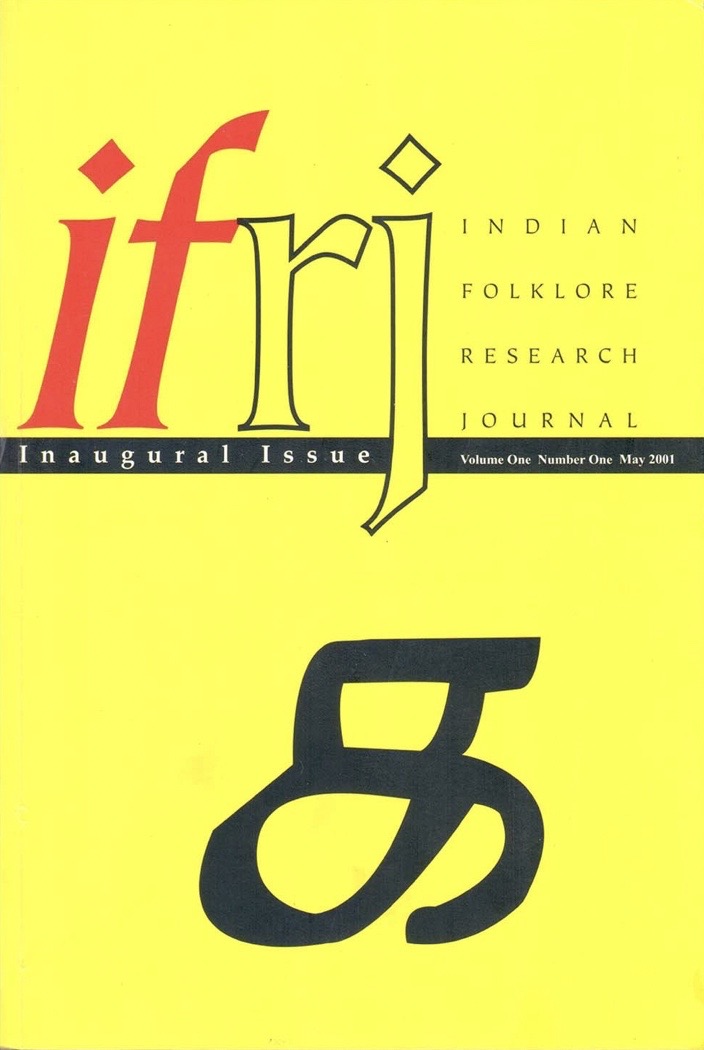
North American Folklorists Facing the Millennium - By Lee Haring
Vol. 1 No. 1 (2001)A look at the issues confronting North American folklorists in the new millennium, beginning with their very nomenclature. Haring looks at the various ways in which Indian and American folklorists can deal with common issues. He describes ‘public folklore’-----the graduates trained by the universities to work in the public realm in various states to document, interpret, popularise and preserve folk and local culture in its various forms. This goes a long way towards improving the collaboration between the public and the academicians. Haring also looks at folkloric expression and literary creativity of diasporic populations, a vital area for Indian folklore research.